
How AI Is Changing the Way We Learn English in 2026
For two decades, technology helped us study English. In 2026, it is finally helping us speak it — and that single shift changes everything for the millions who can read fluently but freeze when it counts.
Every year brings a fresh wave of "AI will revolutionise education" headlines, and most do not survive contact with a real classroom. But strip away the hype and something genuine is happening in 2026: AI English learning has quietly crossed from novelty to infrastructure. In the last school year alone, the overwhelming majority of students reported using AI to learn — it is no longer the future, it is the default.
So the interesting question is no longer whether people use AI to learn English. They already do. The question is what AI is finally good at that crowded classrooms and first-generation apps never managed — and the answer turns out to be the exact thing learners have always struggled with most: actually speaking.
"The last decade digitised English content. 2026 is the year AI digitises English practice — the conversation, correction and confidence that, until now, only ever happened with a patient human in the room."
Here are the five shifts redefining how the world learns English this year — and why they land harder in India than almost anywhere else.
The five shifts of 2026
SHIFT 01
Classrooms teach to the middle; AI does not. Adaptive systems map what a learner already knows, pinpoint the exact gaps, and adjust in real time — the difference between a fixed textbook chapter and a tutor who notices you keep missing the same tense. Where schools have deployed adaptive AI instruction well, they have reported double-digit jumps in outcomes, largely because gaps get caught before they compound.
SHIFT 02
This is the big one. For most of its history, language technology optimised for what was easy to grade: vocabulary lists, grammar drills, multiple-choice. Speaking — the skill people actually want — stayed locked behind the availability of a human partner. AI rewrites that economics. A speech engine can now listen to a full spoken answer and respond to pronunciation, pace and fluency on the spot, as many times as a learner needs, at no extra cost. Practice that used to be scarce just became effectively unlimited.
SHIFT 03
Ask anyone why they do not speak English more often and the honest answer is rarely grammar — it is the fear of being judged. The quiet superpower of AI practice is that it removes the audience. You can stumble, restart, and try the same sentence ten times with nobody sighing across the table. The loop between attempt and correction shrinks from days to seconds, and that loop is precisely where fluency is built.
SHIFT 04
The goalposts have moved. Learners in 2026 are not studying English for a certificate on the wall; they are studying for an interview next month, a client call, a promotion. The measure of success is no longer a test score — it is whether you can hold your own in the room. This reframing, more than any single feature, is what makes AI English learning feel urgent rather than optional.
SHIFT 05
The old failure mode of language apps was the graveyard of good intentions — downloaded in January, forgotten by February. The 2026 model leans on short, daily, AI-guided micro-practice that fits a real schedule, with nudges that keep learners consistent without guilt. The important caveat: AI works best as the everyday companion, not the whole journey. Consistency is where it shines.
Why this matters more in India than almost anywhere
India produces the world's largest pool of graduates, and on paper a growing share are employable — the India Skills Report 2025 put overall graduate employability at around 55%. But "employable on paper" and "signed offer letter" are two very different things.
Employers keep naming the same culprit. Communication — specifically spoken English — is repeatedly cited as the single biggest barrier between a qualified candidate and a job. By one widely quoted estimate, more than half of graduates who clear the technical bar still fail interviews on spoken English and presentation, not on competence. A capable engineer can lose the role to a less qualified candidate who simply speaks with more confidence.
This is exactly the gap AI is built to close at scale. No system of human tutors could ever staff millions of learners each needing personalised speaking practice. An AI speech engine can — and that is why, for India, the 2026 shift from studying English to speaking it is not a trend story. It is an employability story.
See the difference real-time speaking feedback makes.
Create your account →What AI still cannot do
None of this means teachers are obsolete — and any honest take on 2026 has to say so. The hype cycle loves the headline that AI will replace the classroom, but that is not what the evidence shows. The most accurate read is a division of labour: AI handles the parts that scale — drills, correction, endless judgement-free practice — while humans handle the parts that do not: motivation, nuance, encouragement, and the spark of a genuine conversation.
The platforms that win this decade will be the ones that combine both, not the ones promising to make the other redundant. AI is the practice partner that never gets tired; the teacher is still the reason a learner shows up.
What this means for you
For learners, the takeaway is refreshingly simple: stop only consuming English and start producing it. Reading one more grammar guide will not move your fluency the way speaking out loud — and getting instant feedback — will. The tools to do that, daily and without judgement, finally exist.
That is the principle Lanquill is built on. Rather than another vocabulary app, it is an AI English learning platform that works across all six skills — Listening, Speaking, Reading, Writing, Grammar and Vocabulary — with an AI speech analyzer that gives real-time feedback on how you actually sound, and bilingual support that explains your mistakes in your own language. For institutions, the same engine powers an AI language lab for colleges built squarely around placement and employability outcomes.
If you want to go deeper, see why every college needs an AI language lab in 2026, and how AI is reshaping placement readiness on Indian campuses.
Frequently asked questions
AI English learning uses artificial intelligence to personalise lessons, analyse a learner's speech in real time, and give instant feedback on pronunciation, fluency, grammar and vocabulary — replacing one-size-fits-all material with an adaptive path built for each learner.
Yes. The biggest change in 2026 is that AI speech engines can listen to a full spoken answer and give feedback on pronunciation, pace and fluency instantly and as many times as you like — the repeated, low-pressure practice that genuinely builds speaking confidence.
No. AI handles the parts that scale — drills, correction, unlimited practice — while teachers supply motivation, judgement and real conversation. The strongest outcomes come from combining the two, not replacing one with the other.
It is especially effective there. Most candidates lose offers on spoken communication rather than technical skill. AI mock practice lets you rehearse interview answers repeatedly with feedback until you sound fluent and confident under pressure.
Stop studying English. Start speaking it.
Join learners building real speaking confidence with instant AI feedback — across all six language skills.
Related Articles
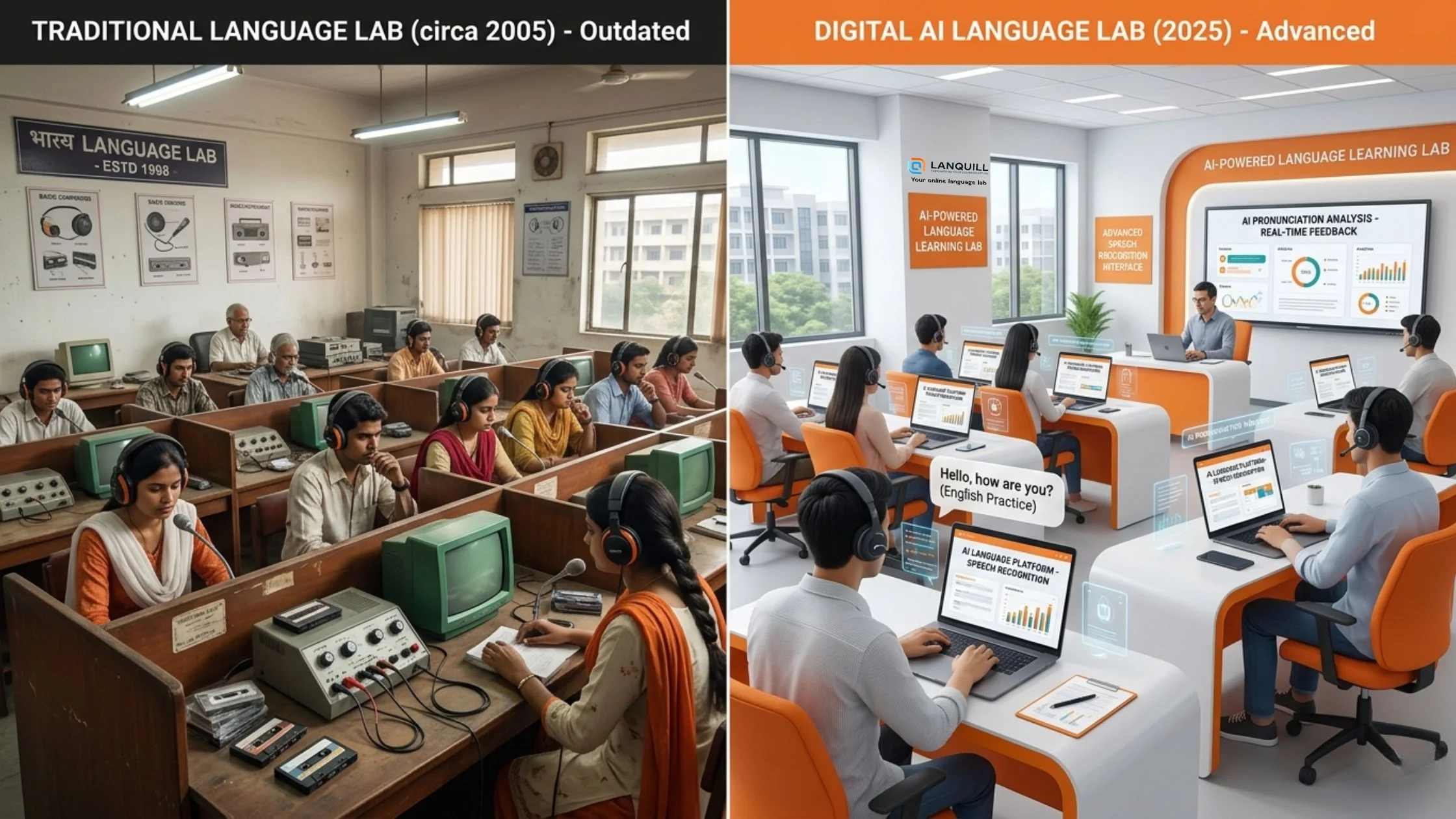
Traditional vs Digital Language Labs for Colleges (2026 Guide)
Compare traditional vs digital language labs and discover which is better for colleges to improve communication skills and placement outcomes.

What is an English Language Lab for Colleges? Benefits Explained
Learn what an English language lab for colleges is and how it improves communication skills, placement readiness, and student outcomes.

Why Every College Needs an AI Language Lab in 2026
Discover why every college needs an AI language lab in 2026 to improve student communication and placement readiness.
From Classroom to Career: How CEFR-Aligned English Courses Build Employability
Learn how CEFR-aligned English courses improve workplace communication and career readiness.

How Modern English Language Labs Are Transforming Communication Skills in Classrooms
Explore how modern language labs improve communication skills using technology.
English Spoken Classes vs English Language Lab: Key Differences You Should Know
Compare spoken English classes and language labs to understand their approaches and outcomes.