
English language lab cost in India: a transparent 2026 breakdown
There is no single price for a language lab - but there is a reliable way to work out what any quote will really cost you. Here is the method, and our own rates.
Search for what an English language lab costs in India and you will find very few numbers, and none you can act on. That is not evasiveness so much as structure: this category is priced by quotation, and quotes swing widely on seat count, hardware specification, bundled modules, region and how far into your approval cycle you already are.
Any article claiming a single figure is guessing. What genuinely helps is knowing which model you are being quoted, which costs get left out of it, and how to convert competing proposals to one comparable number. That is what this page gives you, along with our own pricing.If you are still deciding whether you need a lab at all, start with what an English language lab does for colleges. If the decision is made and you are costing it, read on.
Three ways this gets priced
Identify which model is in front of you before comparing anything. They are not interchangeable, and a headline figure from one tells you nothing about the other.
One-time system
Perpetual licence plus hardware, installed on campus. Paid once, with maintenance charged separately after warranty. Capital cost, fixed seats.
Per terminal
Licensed against student consoles, regardless of how many learners rotate through them. Fixed seats.
Per user, per year
Licensed against enrolled learners, hosted centrally. No hardware, maintenance or refresh cycle. Operating cost, scales with cohort.
For your budget file the distinction decides everything: the first two need a capital approval cycle and depreciate, the third comes out of an annual budget. It is also worth being clear what you are replacing - the economics differ sharply between a lab and outsourced training, covered in English spoken classes vs English language lab.
What varies, and by how much
Rather than quote a range that will not match your proposal, here is what actually moves the number. Check each against the quote in front of you.
- •Seat count - the single largest driver on any on-campus build, since most costs scale per position.
- •Whether computers are included - frequently excluded on the assumption you reuse an existing lab. This alone can double or halve a quote.
- •Courseware - often licensed separately from the software, and sometimes for a shorter term.
- •Modules bundled - career labs, exam prep and additional languages are usually priced as add-ons.
- •Maintenance - begins after warranty, recurs annually, and is typically a percentage of system value.
- •Refresh cycle - consoles, units and headsets run roughly four to five years.
- •Room, power and supervision - carried by your department, never by the vendor, and almost never in the business case.
For scale: one published college proposal for establishing a language laboratory budgeted ₹14,00,000 for a complete setup, funded through the college development fund and government grants. Treat that as one institution's plan rather than a market rate - the variables above mean another college's figure could reasonably sit at half or double it. Before signing off on any of it, be clear about what the spend is meant to return. We set that out in the seven benefits institutions actually measure.
Our pricing
We license per user, per year. There is no lab room, master console, student unit, installation charge, maintenance contract or hardware refresh, because the platform is cloud-based and runs on devices you already have.
List pricing · 2026
From ₹600 per user, per year
Entry rate. The per-user rate steps down across seven volume tiers. Exclusive of applicable taxes.
- 1 – 250 users₹600
- 251 – 500 users₹000
- 501 – 1,000 users₹000
- 1,001 – 2,500 users₹000
- 2,501 – 5,000 users₹000
- 5,001 – 7,500 users₹000
- 7,501 – 10,000 users₹000
Tell us your enrolment figure and we will send the rate that applies to your tier, with a three-year total, in writing. Volume rates, and pricing for consortium, government-scheme or university-wide deployments, are quoted on request.
Request pricingBudget for GST properly
This is the line most first-time budgets get wrong. Subscription e-learning and educational software services are generally taxed at 18% GST, and institutions supplying exempt educational services are typically not entitled to claim input tax credit on their inputs. For most colleges that means the 18% is not recoverable - it is simply part of the cost, and it applies whichever model you choose. Treatment varies by institution type and by the scheme a programme runs under, so confirm your position with your finance officer. Then apply the same test to every proposal you are holding, so you are comparing tax-inclusive against tax-inclusive.
The worksheet: costing any quote
Headline prices are not comparable across models. Cost per learner reached is. Run every proposal - ours included - through the same four steps.
STEP 1
Three-year total cost
| One-time system cost, or annual licence × 3 | |
| Hardware not included in the quote | |
| Maintenance × 3 years | |
| Courseware updates and add-on modules | |
| Training, installation, supervision | |
| GST, if not recoverable | |
| A · Three-year total |
STEP 2
Learners actually reached
| Enrolled learners in scope | |
| Seats available at one time (capped models only) | |
| Timetabled sessions available per week | |
| B · Learners who can realistically practise |
B = min( enrolled learners , seats × sessions per week )
STEP 3
Cost per learner reached, per year
| C = A ÷ B ÷ 3 |
STEP 4
Cost per practice hour
| Hours available per learner per year | |
| D = C ÷ hours per learner per year |
Step 2 is where most comparisons fall apart, and it is the step vendors of capped-seat systems would rather you skipped. A lab with a fixed number of positions can only ever reach as many learners as the timetable allows. If your cohort is several times the seat count, dividing by enrolment flatters the quote badly - divide by the learners who can actually get a session. Step 4 usually reorders the shortlist. Two options can land at a similar cost per learner and differ several-fold in what that learner receives - a handful of supervised hours a term against unrestricted access. That shift in delivery model is the subject of how modern language labs are changing classroom delivery.
The variable that decides your real cost
One factor outweighs the rate card, and it is not in any proposal: how many of your learners actually use the thing.Provision a cohort and activate a third of it and your true cost per learner triples, whatever the invoice says. This is the most common failure in bulk campus deployments - accounts created from a student database, credentials sent to addresses nobody checks, no first session scheduled. The licence count looks healthy and the platform sits idle.
Worth asking
Ask any provider - including us - what share of provisioned learners at comparable institutions logged in within the first month, and what onboarding support is included to move that number. It is the single number that determines whether the spend returns anything.
How institutions fund it
The funding route often decides the model more than the price does. Capital builds typically draw on the college development fund or on state and central higher education infrastructure grants, which have historically financed language laboratory facilities. Corporate CSR is a strong third option - education is the largest single category of CSR spending in India, and English communication labs are an established use, particularly for institutions serving rural and semi-urban cohorts. A per-user subscription, being an operating cost, can usually be met from recurring budget without a capital approval at all.
Five questions for any quote
Ask all five, in writing, of everyone you shortlist.
- What is the three-year total, including maintenance, courseware updates and refresh?
- How many learners can practise concurrently, and how many hours each per year?
- What is excluded? Ask for the list of modules and hardware carrying additional cost.
- What are the renewal terms? Get escalation in writing before signing, not at renewal.
- What is the rate at our exact student count, inclusive of tax?
The short version
There is no single price, and anyone quoting one without seeing your numbers is guessing. Establish which model you are being sold, add back everything the quote leaves out, divide by the learners who will genuinely get access, and compare on that basis. Then add 18% if you cannot claim input credit - and check how many of your students actually log in.
Frequently Asked Questions
There is no single figure - the category is priced by quotation and the models are not comparable on their face. A per-user cloud licence starts at ₹600 per user per year exclusive of taxes, reducing across volume tiers, with rates for larger cohorts quoted on request. An on-campus build is a one-time system cost plus recurring maintenance and varies widely with seat count, hardware specification and whether computers already exist. Normalise every quote to cost per learner reached per year.
Convert both to a three-year total including maintenance, courseware updates and refresh, then divide by the learners each will actually reach, then by three. A capped-seat lab reaches only as many learners as the timetable allows, so its cost per learner reached is usually far higher than the headline suggests.
Subscription e-learning and educational software are generally taxed at 18%. Most institutions delivering exempt educational services cannot claim input tax credit, so it is usually a real cost rather than a recoverable one. Confirm with your finance officer before budgeting.
Maintenance after warranty, hardware refresh every four to five years, courseware updates, add-on modules, faculty training, room and power overhead, and staff time to supervise sessions.
College development funds, state and central higher education infrastructure grants, corporate CSR, skill development scheme funding, or the annual operating budget in the case of a subscription.
Get the figure for your student count
Send us your enrolment number and we will return the applicable rate and a three-year total in writing, inclusive of tax. If you are already holding another proposal, we will run it through the worksheet above alongside ours.
Related Articles
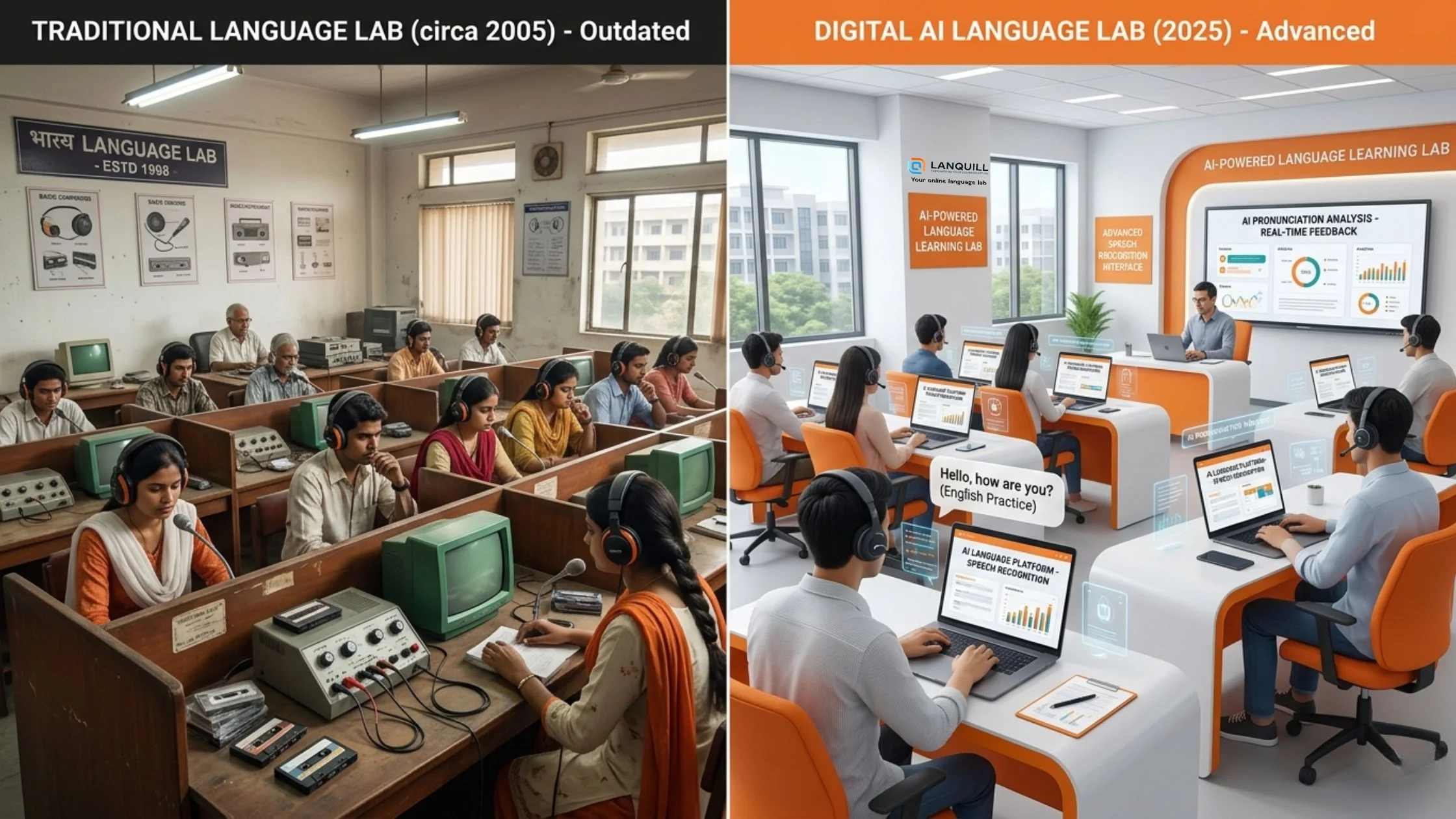
Traditional vs Digital Language Labs for Colleges (2026 Guide)
Compare traditional vs digital language labs and discover which is better for colleges to improve communication skills and placement outcomes.
What is an English Language Lab for Colleges? Benefits Explained
Learn what an English language lab for colleges is and how it improves communication skills, placement readiness, and student outcomes.
Why Every College Needs an AI Language Lab in 2026
Discover why every college needs an AI language lab in 2026 to improve student communication and placement readiness.

From Classroom to Career: How CEFR-Aligned English Courses Build Employability
Learn how CEFR-aligned English courses improve workplace communication and career readiness.

How Modern English Language Labs Are Transforming Communication Skills in Classrooms
Explore how modern language labs improve communication skills using technology.
English Spoken Classes vs English Language Lab: Key Differences You Should Know
Compare spoken English classes and language labs to understand their approaches and outcomes.