
10 Proven Tips to Learn English Fast and Effectively
Ten methods backed by language-acquisition research - and an honest answer to the question most articles avoid: how long this actually takes.
Learning English doesn't have to be a daunting task. Discover 10 proven tips to master English fast and effectively, transforming your language journey today.
But before the tips, one piece of honesty that will make all ten work better: "fast" has a floor. Language learning runs on hours of practice, and no method removes them. What good methods do is stop you wasting the hours you put in - and that difference is enormous. Most learners aren't slow. They're practising the wrong things, in the wrong order, without correction.
The Importance of Learning English
For students and professionals in India, English is rarely about the language itself. It's about what the language unlocks: campus placements where the technical round goes well and the HR round doesn't, roles that were never advertised in your mother tongue, higher study abroad, and the confidence to speak in a meeting rather than nod through it.
That matters because it changes what "learning English" should mean for you. A learner preparing for placement interviews needs fluent, confident speech under pressure. A learner preparing for higher study needs academic writing. Those are different training programmes, and treating them as the same is one of the fastest ways to waste a year.
How long does it actually take?
Here is the number almost no article gives you. Cambridge English estimates that a motivated adult learner needs roughly 100 to 200 guided learning hours to move from one CEFR level to the next, and the requirement grows as you climb. Moving from A1 to A2 typically takes 100–150 hours, while B1 to B2 can take 180–260 hours. Guided learning hours means structured study - lessons, coursework, designed practice - not casual exposure.
| Target level | Approx. cumulative hours from beginner |
|---|---|
| A2 - basic everyday communication | ~200 |
| B1 - independent user | ~350–400 |
| B2 - professional working proficiency | ~500–600 |
| C2 - near-native mastery | ~1,000 |
Guideline figures based on Cambridge English estimates. Individual results vary with first language, prior exposure and study quality.
Read that as freeing rather than discouraging. If you're at B1 and you need B2 for placements, you're looking at roughly 200 hours - which is about forty minutes a day for nine months, or ninety minutes a day over four months. That's a real plan with a real end date, and it's the reason the tips below emphasise daily habit over intensity.
The one thing to take away
You cannot reduce the hours. You can compress the calendar - and you can make sure every hour you spend is an hour that counts. That is what the ten tips below are for.
Setting Clear Goals for Your English Learning Journey
Test yourself at the start, too. Most learners guess their level and guess wrong, usually low, and end up practising material far below what would actually stretch them. Knowing you're a B1 who needs B2 turns a vague ambition into roughly 200 hours of specific work.
Immersive Learning Techniques
This is why "just watch English films" often fails. If you understand 40% of a film, you're not learning English, you're reading subtitles. Start with graded readers, learner podcasts, or news written for language learners, then climb as your comprehension rises.
Speaking practice: the fastest route to fluency
Consuming English is comfortable. Producing it is what changes you - and it's the step most self-taught learners skip for months.
There's a well-established theory behind this. Merrill Swain's comprehensible output hypothesis holds that learning happens when you hit a gap in what you can say: you notice the gap, and that noticing is what pushes you to acquire the missing piece. Reading and listening never trigger that. Only trying to say something does.
If you're weighing structured speaking practice against self-study, we've compared the two approaches in English spoken classes vs English language lab.
Utilizing Technology and Apps for Language Learning
Two cautions on apps. First, a streak measures that you showed up, not that you improved - protect the habit, but judge yourself on whether you can say more this month than last. Second, most apps are heavy on tapping and light on talking. If your goal is speaking, choose tools that make you speak and give feedback on how you sound.
The Role of Consistency in Language Acquisition
Fifteen minutes a day is roughly 90 hours a year. Forty minutes a day is around 240 - a full CEFR level. That's the entire arithmetic of learning English fast, and it's decided by habit, not talent.
Engaging with Native Speakers
"Native speaker" matters less than most people assume. A fluent Indian colleague who corrects you carefully is worth more than a native speaker who politely nods. What you need is accurate feedback, from a person or from a platform that scores your speech automatically.
Effective Reading Strategies for English Learners
Read aloud sometimes, too. It converts reading practice into pronunciation practice at no extra cost in time.
Listening Practices to Enhance Comprehension
Choose clips slightly above your comfort level, and repeat the same clip for several days rather than chasing new material. Familiarity is what lets you focus on how it sounds rather than what it means.
Writing Exercises to Improve Language Skills
For placements specifically, practise the formats you'll be judged on: a professional email, a short self-introduction, a paragraph explaining a project you worked on.
A realistic 30-minute daily routine
Roughly 180 hours a year - close to a full CEFR level.
- 5 min - Shadowing. One short clip, spoken along with, repeated for several days.
- 5 min - Spaced repetition. Vocabulary recall in a flashcard app.
- 10 min - Speaking. Record an answer to one question; listen back once.
- 5 min - Writing. 100 words, submitted somewhere it gets corrected.
- 5 min - Reading. A few pages at a level you can follow comfortably.
Conclusion: Your Path to English Proficiency
Learning English fast isn't about finding a shortcut around the hours. It's about making sure the hours you spend are the right ones: input you can almost follow, output you attempt before you feel ready, correction you actively ask for, and a habit small enough that you keep it on a bad day.
Pick your goal, test your current level, and start today with fifteen minutes. In six months you'll be measurably further than the version of you that waited for the perfect course to begin.
Frequently Asked Questions
Practise daily on the specific skill you need, using material you already understand about 90–98% of, and get corrected regularly. Speaking and writing produce faster gains than passive watching or reading, because producing language forces you to notice what you don't yet know. Fifteen focused minutes daily beats one long weekend session.
Cambridge English estimates roughly 100–200 guided learning hours to move up one CEFR level, growing at higher levels - A1 to A2 takes about 100–150 hours, B1 to B2 about 180–260. Reaching B2 from beginner is commonly estimated at 500–600 hours total. You can't cut the hours, but you can compress the calendar.
Not a full level - that needs more hours than a month contains. You can make real progress on a narrow goal: introducing yourself confidently, handling a set of interview questions, or fixing one specific pronunciation problem. Narrow the goal and 30 days becomes useful.
Both, but correction is the part you can't skip. Self-study builds exposure cheaply; a teacher, a speaking partner or a platform with automated feedback supplies the correction that turns exposure into improvement. Uncorrected practice tends to reinforce existing errors.
Practise answering out loud rather than rehearsing silently, record yourself and listen back, prepare structured answers to the ten most common questions, and seek feedback on pronunciation and fluency - not only grammar. Interviewers assess clarity and confidence far more than vocabulary range.
Find out where you actually stand
Most learners guess their level and guess wrong. Lanquill gives you a measured starting point, daily speaking practice with automated pronunciation feedback, and a progress score you can watch move - the correction step that self-study usually misses.
Related Articles
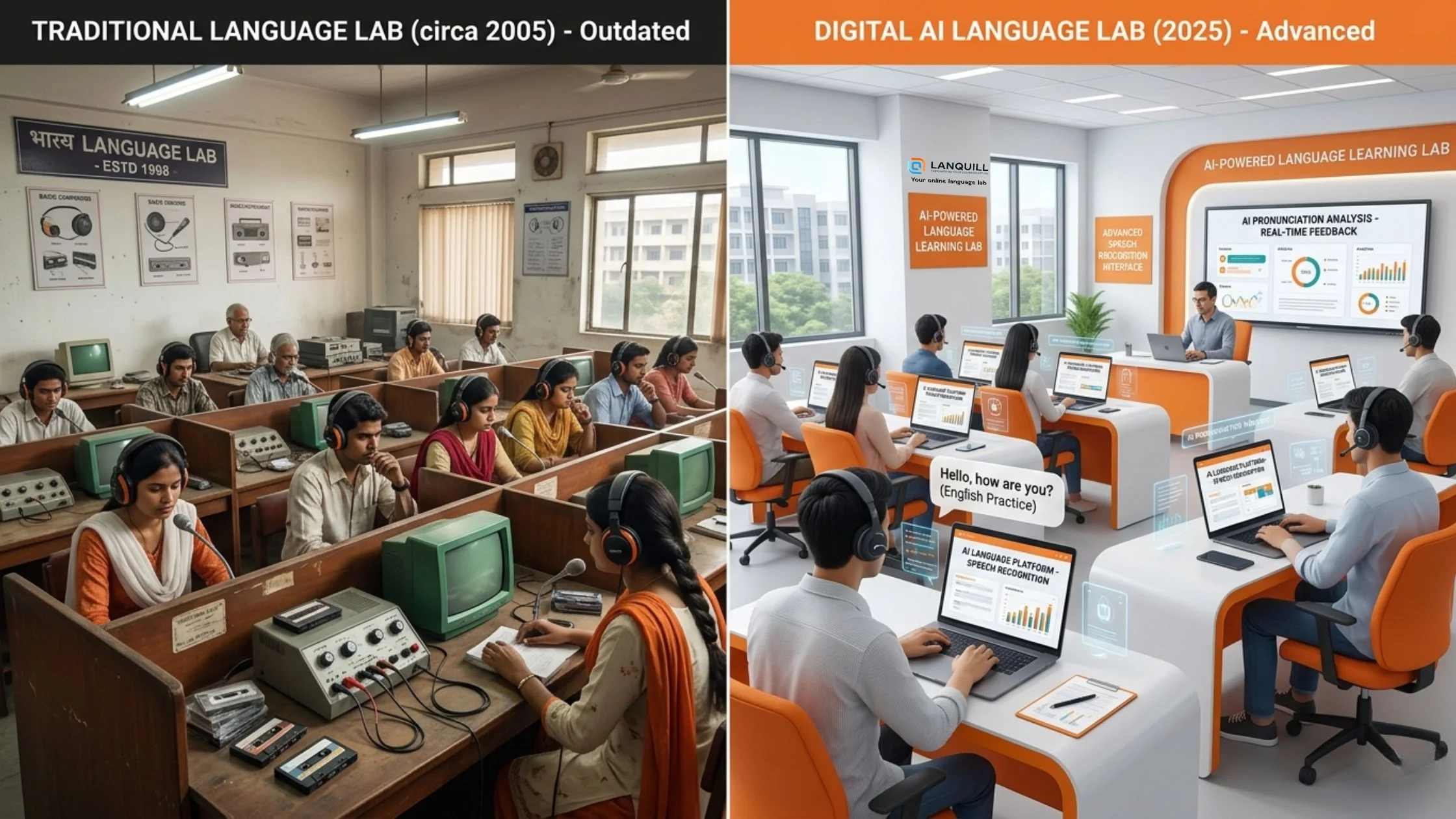
Traditional vs Digital Language Labs for Colleges (2026 Guide)
Compare traditional vs digital language labs and discover which is better for colleges to improve communication skills and placement outcomes.

What is an English Language Lab for Colleges? Benefits Explained
Learn what an English language lab for colleges is and how it improves communication skills, placement readiness, and student outcomes.
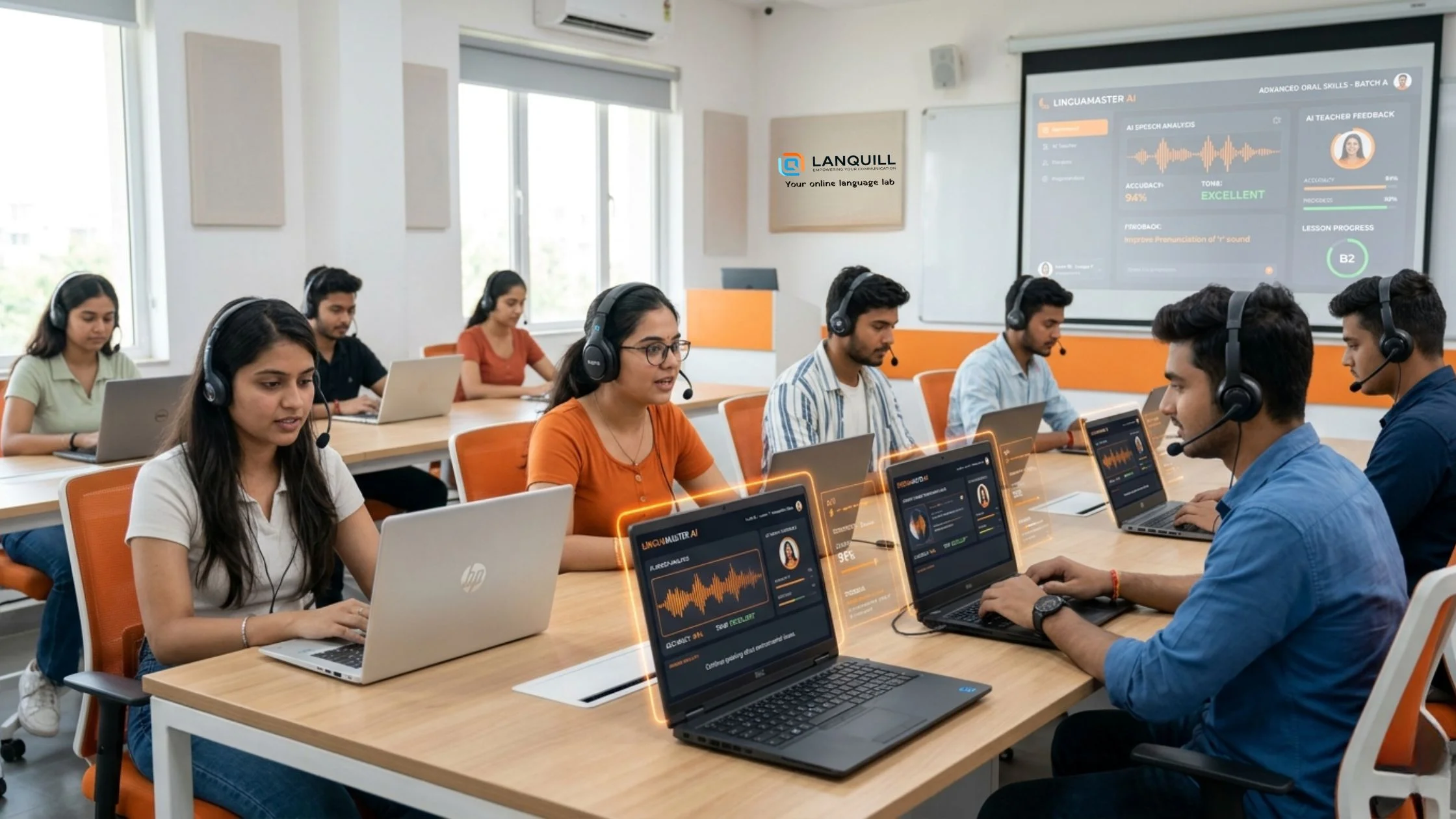
Why Every College Needs an AI Language Lab in 2026
Discover why every college needs an AI language lab in 2026 to improve student communication and placement readiness.

From Classroom to Career: How CEFR-Aligned English Courses Build Employability
Learn how CEFR-aligned English courses improve workplace communication and career readiness.

How Modern English Language Labs Are Transforming Communication Skills in Classrooms
Explore how modern language labs improve communication skills using technology.
English Spoken Classes vs English Language Lab: Key Differences You Should Know
Compare spoken English classes and language labs to understand their approaches and outcomes.