
The placement gap no one trains for: English communication
India's employability is at an all-time high - and communication is still the single biggest thing holding graduates back. For a placement cell, that makes it the highest-leverage fix on the table. Here's how to treat it as a measurable programme, not a pre-placement workshop.
INDIA EMPLOYABILITY · ISR 2026
56.35%
job-ready - up from 54.81% last year
#1 REASON GRADUATES FALL SHORT
Communication
the single largest dimension of the gap
2+
rounds in a typical campus drive screen communication directly - GD and HR interview
#1
communication is the largest single dimension of the employability gap
1yr
realistic time to move a cohort up a proficiency band - not one semester
21 OCT 2026 · 9 MIN READ · FOR TPOs, DEANS & IQAC
A placement cell can do everything right - line up recruiters, run aptitude prep, schedule mock tests - and still watch good students get rejected in the group discussion and the HR interview. The reason is rarely knowledge. It's expression. And it is the most fixable thing on the list, if it's treated as a year-round programme rather than a workshop in week one of placement season.
The real placement gap
India's graduate employability reached 56.35% in 2026 - a record, up from 54.81% the year before. That's the good news. The uncomfortable half is that barely more than half of graduates clear the job-ready threshold at all, and national studies keep naming the same culprit: communication and English proficiency is the single largest dimension of the employability gap, ahead of domain knowledge or aptitude.
For a placement cell, that's not a soft-skills footnote - it's the biggest lever you have. A student weak in one dimension is classed as not readily employable even with strong marks everywhere else, and communication is the dimension the largest share of underperforming graduates fail on. Fix it, and you raise the ceiling on every drive you run.
You can't add recruiters faster than you can make students ready to convert them. Communication is where conversion is won or lost.
Where communication gets screened
Campus recruitment isn't one test - it's a funnel, and communication is assessed at more than one gate. Most service-tier and IT drives run four to five rounds, and at least two measure communication directly. Written English shows up earlier still, inside aptitude platforms like AMCAT and CoCubes.
The practical takeaway: a student can clear aptitude and technical rounds and still be screened out on how they speak. Three separate communication filters stand between a student and an offer. That's why marks alone don't predict placement - and why communication training moves the number the placement cell is actually judged on.
Why the usual fix fails
The default response is a burst of soft-skills or spoken-English workshops a few weeks before placements. It fails for three structural reasons, none of them about the trainer's quality.
- Too late. Moving a learner up a real proficiency band takes months of practice. A workshop in the final semester can't close a gap that needed a year.
- Too few reps. A handful of group sessions gives each student almost no individual speaking time. Fluency is a motor skill - it's built by frequent practice with correction, not by listening to a session.
- Too shallow on data. Attendance registers tell you who turned up, not who improved. The cell can't show which students are now ready, or prove impact to management or an audit.
The result is a programme that feels busy and changes little - the same students who were weak in August are weak in the interview in November.
Build a programme, not an event
Treating communication as infrastructure - something running quietly across all four years - is what separates colleges whose placement numbers move from those that stay flat. Four stages make it a programme rather than a workshop.
The non-negotiable is individual feedback at scale. A single English faculty member cannot assess the spontaneous speech of two thousand students; this is exactly where an AI English language lab earns its place - every learner gets instant pronunciation and fluency feedback, on their own device, as often as they'll practise. Aligning the whole programme to the CEFR scale (A1–C2) means "improved" becomes a number a recruiter and an accreditor both recognise, and a student finishes with a certificate of the level they actually reached - which matters more now that the 2026 skills data shows hiring shifting toward certifications and proof of ability over diplomas.
Start early, too. A programme that runs from first year gives the students furthest from job-ready - often those from rural and semi-urban, non-English-medium backgrounds - the months they need, instead of a panic in the final semester.
How to measure impact
If you can't measure it, you can't defend the budget or improve the programme. Three numbers, tracked across the same cohort over time, tell the whole story.
- •Activation. What share of enrolled students actually practise? A programme that reaches a third of the cohort can't move cohort placement - this is the number to fix first.
- •Band movement. How far has the cohort moved on the CEFR scale, same students, intake vs now? This is the real outcome - not hours logged.
- •Conversion at the gates. Are more students clearing the GD and HR rounds than last year's cohort at the same stage?
Watch activation first. A platform that looks impressive but only a fraction of students ever log into is measuring your most motivated learners, not your cohort - and those are the students who'd have been fine anyway. We break this down in how to track English improvement.
The accreditation bonus
The same data that proves placement impact doubles as accreditation evidence - which turns a placement initiative into an institution-wide win. NAAC assessors look for documented mechanisms that assess learning levels, support advanced and slow learners differently, and evaluate outcome attainment; cohort-level CEFR movement answers all three. And under the NBA's revised framework, Communication is a named Program Outcome in its own right - assessed speaking and writing scores are exactly the direct-assessment evidence it calls for, carrying more weight than the feedback forms most colleges submit.
A communication programme built to lift placements produces, as a by-product, the direct outcome evidence NAAC and NBA ask for. Few placement investments pay into accreditation at the same time.
Where to start this term
You don't need a campus-wide rollout to begin. The fastest way to prove the model is a scoped pilot the placement cell owns.
- Baseline one cohort - a single pre-final-year batch - so you have an honest starting distribution, not a guess.
- Run daily practice for a semester with feedback, and chase activation hard in the first month: credentials out, first session timetabled, non-starters followed up.
- Report band movement and GD/HR conversion against the rest of the cohort. That one comparison is your business case for scaling - and your accreditation exhibit.
For the cost side of that decision, see the English language lab cost breakdown; to choose a platform, the buyer's guide walks through what to evaluate.
Frequently asked questions
Most drives screen communication at two or more stages - the GD and the HR interview - plus written English in aptitude tests. A student can clear aptitude and technical rounds and still be eliminated on expression. National studies find communication to be the single largest dimension of the employability gap, so strong marks and weak communication frequently end in rejection.
Treat it as a programme, not an event: baseline every student, give daily speaking and writing practice with feedback, track progress on the CEFR scale, and intervene early for those furthest behind. One-off workshops before placement season are too late and reach too few students to move cohort outcomes.
It's assessed directly in GDs and HR interviews and indirectly in written tests, so it gates conversion at several points. Employability research names it the largest single factor separating job-ready graduates from the rest. Improving it lifts the share of students who convert the interviews they already get.
From the first year, not the final-year placement season. Moving a learner up a band takes months, so a final-semester programme can't close a real gap before drives begin - and starting early builds measurable improvement into your accreditation evidence.
Track three things across the same cohort over time: activation (who actually practises), CEFR band movement, and conversion at the communication-gated rounds. Cohort CEFR movement also serves as direct evidence for NAAC and NBA files.
Turn communication into a number your placement cell can report
We'll show your TPO and IQAC teams how Lanquill baselines a cohort, runs daily AI-feedback practice, and reports CEFR band movement and conversion - on a live dashboard, with a scoped one-semester pilot you can take to management.
Related Articles
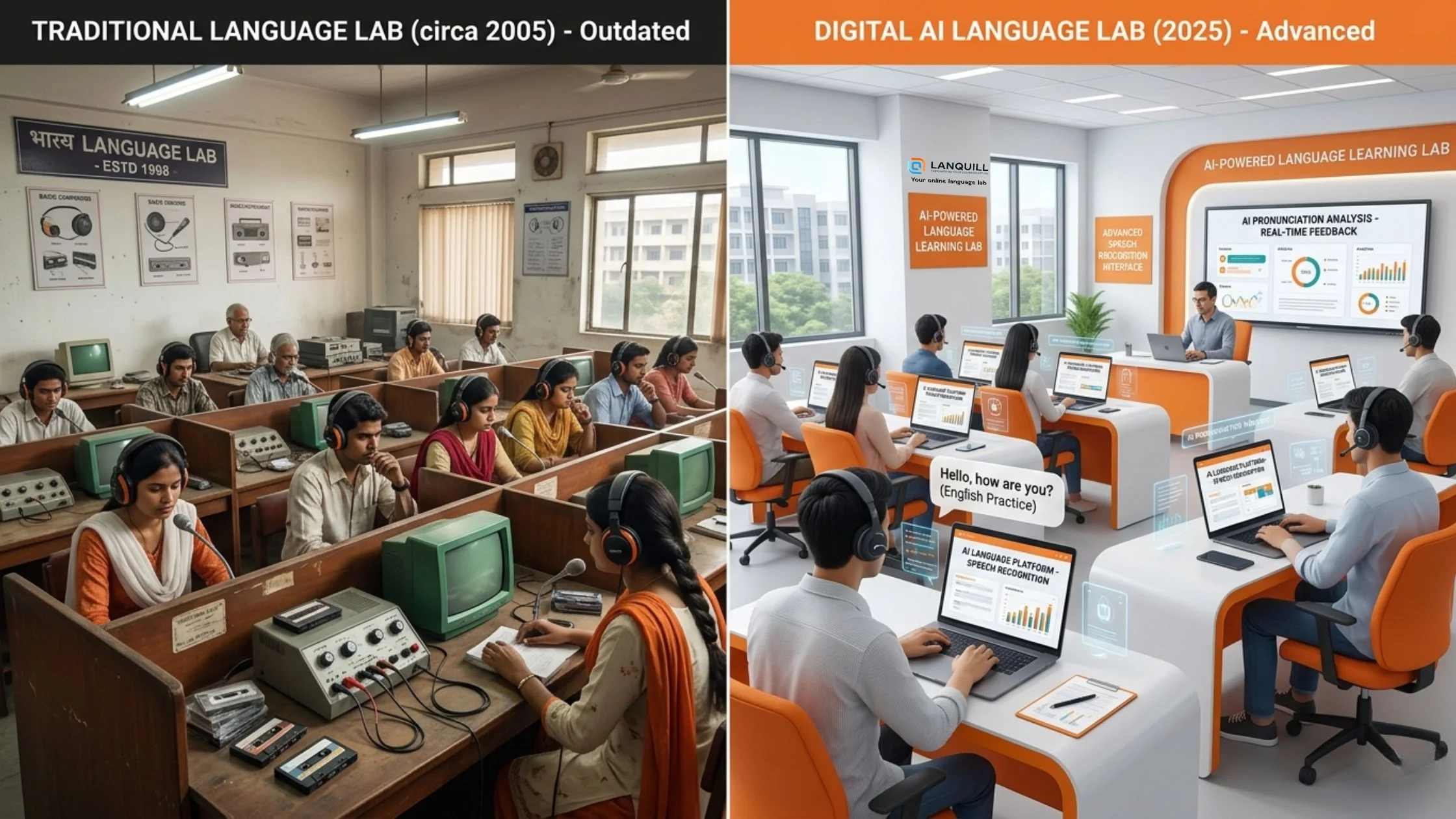
Traditional vs Digital Language Labs for Colleges (2026 Guide)
Compare traditional vs digital language labs and discover which is better for colleges to improve communication skills and placement outcomes.
What is an English Language Lab for Colleges? Benefits Explained
Learn what an English language lab for colleges is and how it improves communication skills, placement readiness, and student outcomes.
Why Every College Needs an AI Language Lab in 2026
Discover why every college needs an AI language lab in 2026 to improve student communication and placement readiness.

From Classroom to Career: How CEFR-Aligned English Courses Build Employability
Learn how CEFR-aligned English courses improve workplace communication and career readiness.

How Modern English Language Labs Are Transforming Communication Skills in Classrooms
Explore how modern language labs improve communication skills using technology.
English Spoken Classes vs English Language Lab: Key Differences You Should Know
Compare spoken English classes and language labs to understand their approaches and outcomes.