
How to Improve Your OET Listening Score: Strategies for Parts A, B, & C

The OET Listening sub-test is one of the most challenging parts of the Occupational English Test for healthcare professionals. Unlike general English exams, OET Listening is profession-specific, testing your ability to understand patient consultations, healthcare talks, and clinical instructions.
Whether you’re a doctor, nurse, or other healthcare worker, your OET Listening score directly reflects your ability to handle real-life medical communication. The good news is: with the right strategies and consistent practice, you can significantly boost your performance.
In this blog, we’ll break down practical strategies for OET Listening Part A, Part B, and Part C, share actionable OET Listening tips, and recommend how you can prepare effectively with Lanquill’s OET Preparation Course.
Structure of the OET Listening Test
Before diving into strategies, let’s quickly review the structure.
- Duration: 40 minutes (including 5 minutes for checking answers)
- Format: 42 questions across 3 parts (A, B, and C)
- Focus: Real healthcare workplace scenarios
Breakdown:
- Part A (Consultation Extracts): 24 questions
- Part B (Short Workplace Extracts): 6 questions
- Part C (Presentation Extracts): 12 questions
Part A: Consultation Extracts (24 Questions)
What it tests:
Your ability to follow doctor-patient consultations and extract key details. You’ll be required to complete notes while listening.
Common Challenges:
- Writing while listening
- Missing important details
- Spelling and accuracy
Strategies to Improve OET Listening Part A:
- Master Note-Taking Formats: Familiarize yourself with abbreviations and shorthand writing. Example: “BP ↑” for “blood pressure increased.”
- Predict the Information: Skim the notes before the recording begins. Anticipate the type of word needed (e.g., “medication name,” “dosage,” “symptom”).
- Focus on Key Details: Pay attention to numbers, times, medical terms, and patient history. These are the most common answers.
- Don’t Panic if You Miss One: Keep moving. The audio plays only once, so don’t get stuck on a missed word.
- Practice Active Listening Daily: Listen to medical podcasts, consultations, or case discussions. Practice summarizing the key points in note form.
👉 Pro Tip: Use Lanquill’s OET Listening Practice Modules to train with 700+ hours of consultation-style audios and note-taking exercises.
Part B: Short Workplace Extracts (6 Questions)
What it tests:
Your ability to understand short workplace conversations or announcements in a healthcare setting. Each extract is followed by a multiple-choice question with three answer options.
Common Challenges:
- Distinguishing the main idea from minor details
- Identifying the speaker and their role (e.g., doctor, nurse, administrator)
- Navigating similar or confusing answer choices
Strategies to Improve OET Listening Part B:
- Identify the Context Quickly: Determine the setting (e.g., nurse-to-nurse handover, hospital announcement, or staff meeting) to anticipate key information.
- Focus on the Speaker’s Role: Note who is speaking (e.g., doctor, nurse, administrator) and their purpose (e.g., informing, instructing, requesting) to guide your understanding.
- Eliminate Wrong Options: Rule out distractors that are too specific, irrelevant, or inconsistent with the audio’s main point.
- Listen for Tone and Function Words: Pay attention to phrases like “I recommend,” “Please ensure,” or “The next step is,” as they often signal the correct answer.
- Practice with Real Clinical Conversations: Train with authentic audio materials that mimic hospital settings, such as staff briefings or instructions. Lanquill offers tailored practice to prepare you for test day.
👉 Pro Tip: Use Lanquill’s OET Listening Practice Modules, featuring authentic workplace scenarios, to build confidence in identifying key details and selecting correct answers.
Part C: Longer Talks and Lectures (6 Questions)
What it tests:
Your ability to comprehend longer presentations, lectures, or interviews on healthcare topics. Each extract is followed by multiple-choice questions with three answer options.
Common Challenges:
- Maintaining focus during extended audio segments
- Following the structure of complex lectures or talks
- Understanding specialized medical vocabulary
Strategies to Improve OET Listening Part C:
- Follow the Structure of the Talk: Recognize the typical flow of presentations (introduction, key points, examples, conclusion). Listen for linking words like “Firstly,” “In contrast,” or “To summarize” to track the speaker’s argument.
- Take Keywords, Not Sentences: Avoid writing full sentences. Jot down essential terms, transitions, and figures to capture the main ideas efficiently.
- Listen for Attitude and Opinion: Pay attention to the speaker’s tone (e.g., enthusiastic, cautious, critical) to identify their attitude or purpose, as questions often focus on these aspects.
- Practice Concentration: Build stamina by listening to medical lectures, research talks, or healthcare-related TED Talks. Practice following arguments for 5–7 minutes without losing focus.
- Use Repetition as a Tool: Replay practice audios multiple times to improve comprehension. Lanquill’s OET Listening Practice Modules include lectures with transcripts to help you analyze missed details.
👉 Pro Tip: Use Lanquill’s OET Listening Practice Modules, featuring real-world medical lectures and transcripts, to enhance your ability to follow complex talks and ace Part C.

General OET Listening Tips
- Practice Under Exam Conditions:Avoid pausing the audio; simulate real test conditions.
- Improve Medical Vocabulary: Learn common medical terms, abbreviations, and patient instructions.
- Check Spelling & Grammar: In Part A, correct spelling matters.
- Balance Speed & Accuracy: Write quickly, but don’t sacrifice legibility.
- Review Mistakes: Always go back to see why you got an answer wrong.
How Lanquill Helps You Improve Your OET Listening Score
Preparing for OET on your own can be overwhelming. That’s why Lanquill offers a complete OET Preparation Course Online designed for healthcare professionals.
With Lanquill, you get:
- OET Listening Practice for All 3 Parts: Consultations, briefings, and lectures.
- 700+ Hours of Learning Modules: Extensive exercises covering Listening, Reading, Writing, Speaking, Grammar & Vocabulary (LSRWGV).
- CEFR-Aligned Certificate:Get certified from pre-A1 to C2 levels to boost your international career.
- Healthcare-Specific Scenarios: Every module reflects real hospital and clinical communication.
- Flexible Online Learning: Access anytime, anywhere, at your own pace.
💡 Tip: Enroll at Lanquill OET Preparation Course Online today and take the next step toward achieving your desired OET score.
FAQs
Focus on practicing each part of the OET Listening test separately. For Part A, work on notetaking; for Part B, practice identifying speaker roles; and for Part C, train to follow lectures and presentations. Regular practice with healthcare-related audios is essential.
Many candidates find Part C the most challenging because it involves longer healthcare talks or interviews. Staying focused, taking keyword notes, and recognizing the structure of the talk can make this section easier.
The Listening test has 42 questions across Parts A, B, and C. Answers are marked as correct or incorrect, and scores are converted into grades from A (highest) to E. Most healthcare councils require a Grade B (around 30–35 correct answers).
Yes. Platforms like Lanquill offer OET Listening practice with 700+ hours of modules, covering consultations, staff meetings, and healthcare lectures, so you can prepare online anytime.
Learn medical note-taking formats, use abbreviations, and predict the type of information required before listening. Focus on key details such as symptoms, medications, and patient history.
It depends on your current English level, but most candidates need at least 4–6 weeks of consistent practice. Intensive courses like Lanquill’s OET Prep can accelerate this process with structured learning.
Absolutely. Knowing common medical terms and abbreviations improves your ability to understand consultations, instructions, and lectures quickly and accurately.
Conclusion
Improving your OET Listening score is not just about practice—it’s about using targeted strategies for each part of the test.
In Part A, focus on effective note-taking and anticipating answers.
In Part B, sharpen your ability to understand context and speaker roles.
In Part C, train yourself to follow lecture structures and analyze tone.
With the right preparation and expert guidance, you can boost your confidence and performance. And with Lanquill’s comprehensive OET preparation program, you’ll have all the tools you need to succeed.
Related Articles
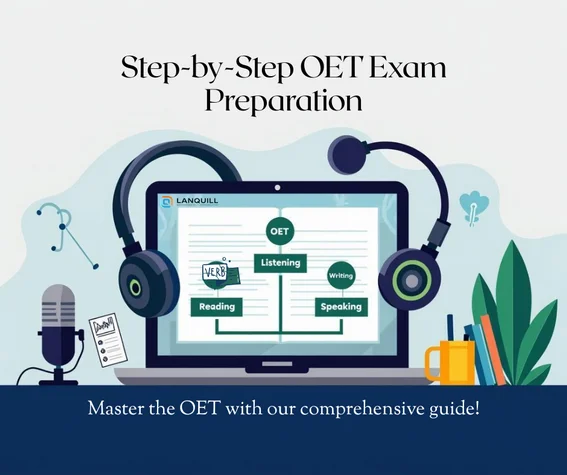
Step-by-Step OET Exam Online Preparation: Listening, Reading, Writing & Speaking
The Occupational English Test (OET) is one of the most recognized English language proficiency exams for healthcare professionals worldwide.Accepted in countries like the UK, Australia, New Zealand, Ireland, and Singapore,

OET vs. IELTS for Doctors: Which English Test is Right for Your Career?
Healthcare professionals planning to practice or study abroad often face a crucial decision: Which English proficiency test should I take—OET or IELTS? Both tests are widely recognized, but their focus, structure, and relevance to the medical field differ significantly.